
EN39/BS1139 and JIS G3444 Standards for Scaffolding Pipes: A Guide to Choosing Safe and High-Quality Pipes
Understanding Scaffolding Pipes and Their Functions
In the construction and industrial sectors, scaffolding is used as a temporary structure to help workers carry out activities at heights, in confined areas, or in locations that are difficult to access. Scaffolding is widely used for installation, inspection, painting, maintenance, repair, and access work in project areas.
One of the main components in a scaffolding system is the scaffolding pipe. This pipe serves as the main frame that supports the scaffolding structure. Since it is directly related to workplace safety, scaffolding pipes should not be selected carelessly.
The pipes used must have the appropriate dimensions, thickness, length, strength, and surface protection. To ensure this, scaffolding pipes generally refer to certain standards, such as EN39/BS1139 and JIS G3444.
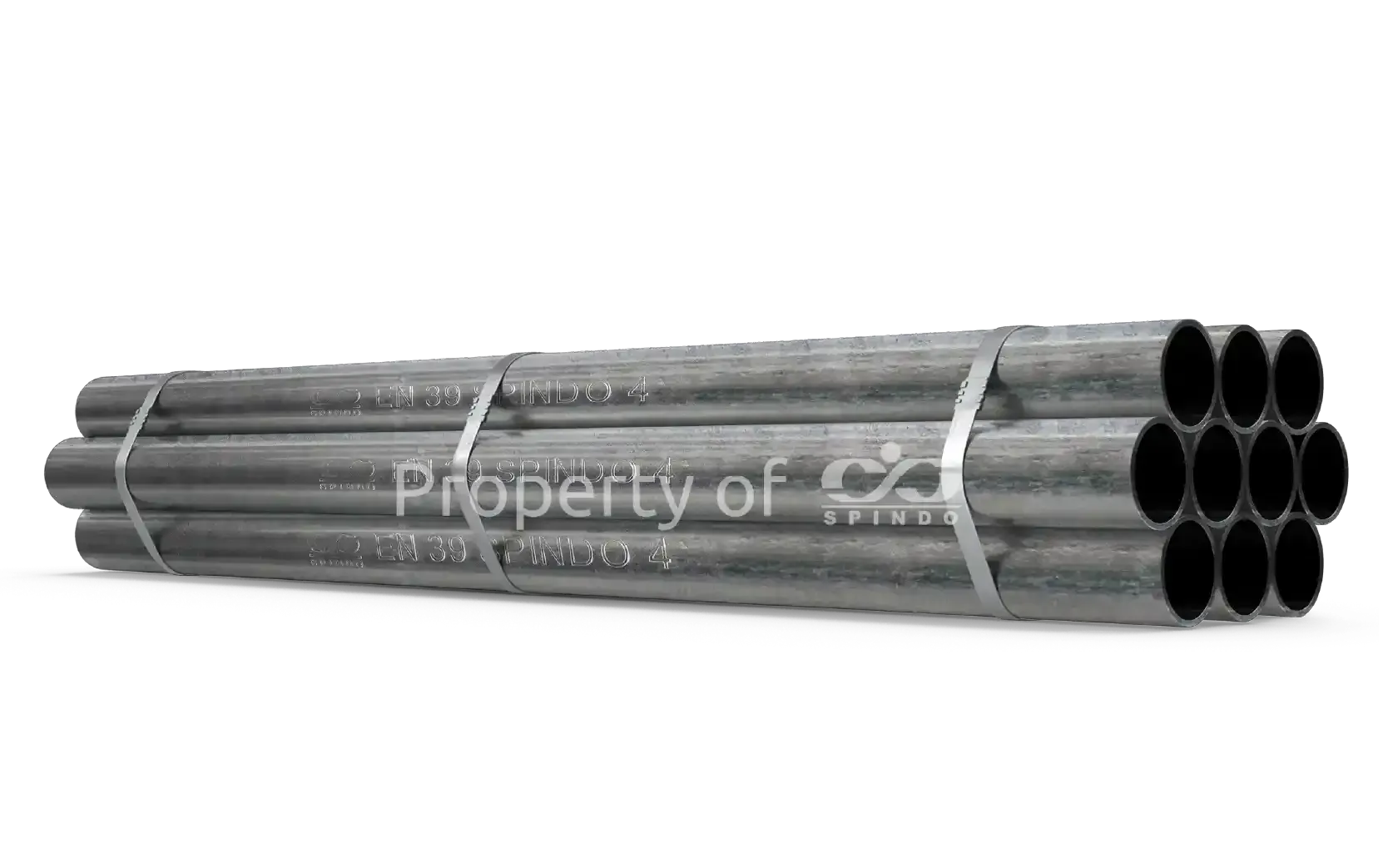
As a national steel pipe manufacturer, PT STEEL PIPE INDUSTRY OF INDONESIA Tbk (SPINDO) provides steel pipes for scaffolding applications that comply with EN39/BS1139 and JIS G3444 standards, making them a suitable choice for construction and industrial projects that require high-quality, standard-compliant scaffolding pipes.
What Are EN39/BS1139 and JIS G3444 Standards?
EN39/BS1139 is a standard commonly used for scaffolding pipes in tube and coupler scaffolding systems. This system uses steel pipes as the main frame and couplers or clamps as connectors between pipes.
Meanwhile, JIS G3444 is a Japanese standard for structural steel pipes that can also be used in scaffolding applications. This standard is commonly applied to temporary structures and certain construction applications that require steel pipes with measurable specifications.
For general readers, standards such as EN39/BS1139 and JIS G3444 can be understood as “technical guidelines” that help ensure pipes have the right size, thickness, and quality for use in scaffolding systems.
By using standard-compliant scaffolding pipes, users are not simply purchasing ordinary steel pipes, but pipes specifically designed to support worksite requirements.
Scaffolding Pipe Dimensions
Pipe dimensions are an important factor when choosing scaffolding pipes. These dimensions include the pipe’s outside diameter, wall thickness, and pipe length.
For scaffolding applications,
SPINDO provides pipe dimension options that comply with EN39/BS1139 and JIS G3444 standards.
| Standar | Outside Diameter | Thickness Variants | Pipe Length |
|---|---|---|---|
| EN39/BS1139 | 48,3 mm | 3,2 mm and 4,0 mm | 6000 mm (6 m) |
| JIS G3444 | 48,6 mm | 2,3 mm, 2,5 mm, 2,8 mm, dan 3,2 mm | 6000 mm (6 m) |
The diameter difference between 48.3 mm and 48.6 mm may seem small. However, in a scaffolding system, this size remains important because it affects the compatibility of the pipe with clamps, couplers, and other locking components.
If the pipe size is not suitable, the installation process may become less precise. This can affect the stability of the scaffolding structure on site.
Scaffolding Pipe Thickness Variants
In addition to diameter, pipe thickness is also an important factor. Pipe thickness affects strength, durability, and suitability for use in various project conditions.
For the EN39/BS1139 standard, scaffolding pipes are available in the following thickness variants:
- 3.2 mm
- 4.0 mm
Meanwhile, for the JIS G3444 standard, the available thickness variants are:
- 2.3 mm
- 2.5 mm
- 2.8 mm
- 3.2 mm
The selection of pipe thickness should be adjusted to project requirements. For general construction work, the required pipe thickness may differ from that needed for heavy industrial projects such as oil and gas refineries, offshore facilities, onshore facilities, or tankers.
The heavier the working conditions and the higher the safety requirements, the more important it is to choose scaffolding pipes with the appropriate specifications.
Scaffolding Pipe Length
SPINDO scaffolding pipes for EN39/BS1139 and JIS G3444 standards are available in a length of 6000 mm, or 6 meters.
This length is commonly used because it is flexible for various scaffolding installation requirements. Six-meter pipes can be used for vertical frames, horizontal frames, or special configurations based on site conditions.
On site, this pipe length makes it easier to use across various project types, including buildings, factories, refineries, offshore facilities, onshore areas, shipyards, and tankers.
Zinc Coating Thickness on Galvanized Scaffolding Pipes
For scaffolding pipes used outdoors or in heavy-duty environments, corrosion protection is an important consideration. One commonly used protection method is galvanizing, which is the process of coating the surface of steel pipes with zinc.
The zinc coating helps protect the pipe from corrosion caused by rain, humidity, sea air, and aggressive industrial environments. This is especially important for applications such as:
- Oil and gas refineries
- Offshore facilities
- Onshore facilities
- Coastal areas
- Shipyards
- Tankers
For certain project requirements, zinc coating thickness can be one of the parameters that needs to be considered. The harsher the operating environment, the more important it is to ensure that the pipe’s surface protection meets the project specifications.
When ordering scaffolding pipes, zinc coating requirements should be communicated from the beginning. This allows the selected product to be adjusted to site conditions and the required coating standards.
Applications of Standard Scaffolding Pipes
Standard scaffolding pipes are not only used for general building projects. In practice, scaffolding pipes are also widely used in various industrial sectors that require safe, strong, and flexible access systems.
- Building and Infrastructure Construction
In building, bridge, warehouse, factory, and public facility projects, scaffolding is used for facade work, painting, installation, maintenance, and access work at heights.

- Oil and Gas Refineries
In oil and gas refinery areas, scaffolding is used for maintenance activities, shutdown projects, turnarounds, equipment inspections, piping work, and production facility maintenance. These areas require scaffolding pipes with clear specifications because they are related to workplace safety and strict project standards.
- Onshore Facilities
In onshore facilities such as refineries, petrochemical plants, power plants, and other heavy industrial areas, scaffolding is used for access work, inspection, repair, and maintenance. Standard scaffolding pipes help support work in complex and challenging areas.
- Offshore Facilities
In offshore facilities, scaffolding is used on offshore platforms and oil and gas production facilities. Offshore environments pose greater challenges due to exposure to sea air, high humidity, and corrosion risks. Therefore, selecting pipes with the right standards and surface protection is very important.
- Shipyards and Tankers
In the shipyard and tanker industries, scaffolding is used for fabrication, blasting, painting, inspection, and maintenance work. Work areas on tankers often have complex structures, limited space, and potentially corrosive environments. Therefore, standard scaffolding is a safer and more measurable choice.
Differences Between Ordinary Scaffolding and Standard Scaffolding
In the field, many people still assume that all scaffolding is the same. In fact, there are important differences between ordinary scaffolding and standard scaffolding.
Ordinary scaffolding is generally viewed only from its basic function as a temporary structure. Meanwhile, standard scaffolding considers the technical specifications of the pipe, such as size, thickness, material quality, surface protection, and compatibility with clamp or coupler systems.
| Aspect | Ordinary Scaffolding | Standard Scaffolding |
|---|---|---|
| Technical reference | Often unclear | Refers to standards such as EN39/BS1139 and JIS G3444 |
| Pipe dimensions | May vary | Diameter and thickness are more measureable |
| Pipe thickness | Not always consistent | Follows thickness variants according to the standard |
| Compatibility with clamps/couplers | May be less precise | Better suited to scaffolding systems |
| Surface protection | Varies | Can be adjusted, for example with zinc coating |
| Project documentation | Often limited | More suitable for professional project requirements |
| Applications | Generally for light-duty work | Suitable for construction, oil and gas, offshore, onshore, shipyards, and tankers |
The main difference is quality assurance. Standard scaffolding provides more consistent dimensions, clearer specifications, and better suitability for project needs.
For high-risk projects such as oil and gas refineries, offshore facilities, onshore facilities, and tankers,
the use of standard scaffolding pipes becomes increasingly important because it is related to worker safety, temporary structure stability, and smooth site operations.
Why Choose SPINDO Scaffolding Pipes?
As a national steel pipe manufacturer, SPINDO provides steel pipes for scaffolding applications that comply with EN39/BS1139 and JIS G3444 standards. These products are available in outside diameters of 48.3 mm and 48.6 mm, thickness variants ranging from 2.3 mm to 4.0 mm, and a length of 6000 mm.
SPINDO scaffolding pipes can be used for various project needs, from general construction to industrial applications such as oil and gas refineries, offshore facilities, onshore facilities, shipyards, and tankers.
The advantages of SPINDO scaffolding pipes include:
- Referring to clear standards, namely EN39/BS1139 and JIS G3444
- Available in various dimension and thickness options
- Available in 6000 mm pipe length
- Can be adjusted to zinc coating or galvanizing requirements
- Suitable for various construction and industrial project applications
- Supported by SPINDO’s experience as a steel pipe manufacturer in Indonesia
By choosing scaffolding pipes from an experienced manufacturer, contractors, scaffolding applicators, EPC companies, and project owners can obtain materials that are better suited to technical requirements and workplace safety needs.
Conclusion
Scaffolding pipes are an important component in scaffolding systems. Since they are used to support work activities at heights and in high-risk environments, scaffolding pipes must have the appropriate dimensions, thickness, length, and quality.
EN39/BS1139 and JIS G3444 standards help ensure that scaffolding pipes have more measurable specifications. In general, scaffolding pipes are available in outside diameters of 48.3 mm or 48.6 mm, thickness variants from 2.3 mm to 4.0 mm, and a length of 6000 mm.
For use in heavy-duty areas such as oil and gas refineries, offshore facilities, onshore facilities, shipyards, and tankers, surface protection such as zinc coating is also an important factor to consider.
As a national steel pipe manufacturer, SPINDO provides scaffolding pipes that comply with EN39/BS1139 and JIS G3444 standards. With a range of dimensions, thickness variants, pipe length, and experience in the steel pipe industry, SPINDO can be a solution for scaffolding pipes that are safe, high-quality, and suitable for project needs.