
Steel Pipe TKDN: Why Is It Important for Infrastructure Projects?
Infrastructure projects require materials that meet technical specifications, can be traced, and comply with procurement requirements. Steel pipes are among the materials widely used for water networks, building structures, utilities, oil and gas systems, fire protection systems, and industrial facilities. In addition to considering standards, dimensions, wall thickness, and applications, certain projects must also take into account the Domestic Component Level, known in Indonesia as TKDN, of steel pipe products.
TKDN indicates the percentage of domestic content in a product.
In procurement processes that implement the Increased Use of Domestic Products program, or P3DN,
TKDN values and certificates help procurement teams identify products manufactured with domestic content. The P3DN program is intended to increase the use of domestic products, strengthen national industries, and reduce dependence on imports.
What Is Steel Pipe TKDN?
Steel pipe TKDN is a percentage that indicates the level of domestic content in a steel pipe product.
Its calculation is related to production components originating from within Indonesia, including materials or components, labor, production processes, and other supporting elements calculated in accordance with applicable regulations.
A TKDN value allows users to understand the extent to which a steel pipe product involves domestic resources and manufacturing activities.
TKDN certificates are issued through the Center for the Increased Use of Domestic Products under Indonesia’s Ministry of Industry after the required application and verification process.
Because each certificate applies to a specific product and scope, verification should not be based only on the manufacturer’s name. Users must also check the product type, TKDN value, certificate number, and certificate validity period.
Why Is Steel Pipe TKDN Important for Infrastructure Projects?
TKDN is important because infrastructure procurement does not only evaluate the technical capability of a material. It may also assess compliance with policies on the use of domestic products.
- Helps Meet Procurement Requirements
The use of domestic products should be considered from the planning stage in government procurement and other projects subject to P3DN requirements.
Presidential Instruction No. 2 of 2022 encourages the use of domestic products in government procurement of goods and services. The regulation also addresses the use of products with specified TKDN values when domestic products are available that meet the combined requirements for TKDN and Company Benefit Weight, or BMP.
For procurement teams, a TKDN certificate can help with:
- checking a product’s domestic status;
- completing procurement documents;
- evaluating bids;
- matching products with tender requirements; and
- documenting compliance with P3DN policies.
Requirements may vary between projects. Project teams must still review tender documents, contracts, sector-specific regulations, and project owner requirements.
- Supports Indonesia’s Manufacturing Industry
The use of domestically manufactured steel pipes can help maintain demand for the national manufacturing industry.
When local products are used in infrastructure projects, they can support manufacturing capacity, employment, domestic supply chains, manufacturing investment, and the development of industrial capabilities in Indonesia.
The P3DN program is intended to increase the use of domestic production, improve national industrial utilization, reduce dependence on foreign products, and create employment opportunities.
- Supports Tender Document Preparation
TKDN information may form part of the administrative or commercial evaluation in a tender process.
Contractors and suppliers must ensure that the information included in their bid documents corresponds with the applicable certificate. Incorrectly stating the TKDN value, product type, or certificate validity period may create inconsistencies between the bid documents and the materials eventually supplied. Information that should be checked includes:
- manufacturer’s name;
- product name and type;
- certificate number;
- TKDN value;
- certificate validity date;
- production location, when stated;
- covered product specifications or types; and
- compatibility with project requirements.
- Makes Product Origin and Identity Easier to Verify
A TKDN certificate provides more measurable information than general claims such as “local product” or “made in Indonesia.” However, the certificate must still be matched with the actual product being used. One manufacturer may produce different pipe categories covered by different certificate scopes.
Verification should therefore be performed for the specific product, rather than relying only on the manufacturer’s name.
- Can Add Value During Material Selection
For projects that encourage the use of domestic products, the TKDN value may become one of the considerations when comparing material options.
However, TKDN should not be the only basis for selecting a product. A steel pipe with a high TKDN value must still meet the required technical standards, products specifications, production capacity, delivery schedule, and application requirements.
Steel Pipe Applications in Infrastructure Projects
Steel pipes are used in many sectors because they are available in different dimensions, classes, manufacturing methods, and surface protection systems. Common steel pipe applications include:
- water distribution and transmission networks;
- water and wastewater treatment facilities;
- utility systems for industrial and commercial areas;
- building structures and industrial facilities;
- foundations and steel pipe piles;
- oil and gas projects;
- energy distribution networks;
- fire protection systems;
- scaffolding and project access systems; and
- various fabrication requirements.
SPINDO manufactures steel pipes for construction, infrastructure, utilities, oil and gas, furniture, automotive, and other industrial sectors. Its portfolio includes structural pipes, water pipes, oil and gas pipes, GI pipes, stainless steel pipes, and other products for industrial applications.
Because every application has different operating conditions,
steel pipe selection should consider applicable standards, dimensions, material grade, connection method, working pressure, corrosion protection, and system design.
Does TKDN Determine Steel Pipe Quality?
TKDN measures the level of domestic content in a product. It does not measure the product’s quality level or technical performance. A high TKDN value does not automatically mean that a steel pipe is stronger, more resistant to corrosion, or suitable for every application.
The quality and technical suitability of a steel pipe must still be evaluated through:
- product standards;
- material grade;
- diameter and wall thickness;
- mechanical properties;
- manufacturing method;
- connection type;
- coating or lining system;
- technical certification;
- test results; and
- compatibility with the project design.
TKDN and technical standards therefore serve different purposes.
| Aspect | Function |
|---|---|
| TKDN | Indicates the level of domestic content in a product |
| Technical certificate or standard | Indicates conformity with specific quality requirements |
| Project specification | Defines material requirements based on the design and application |
| Test documentation | Provides evidence of product inspection or testing |
Steel pipes selected for a project should satisfy both requirements: technical suitability and procurement compliance.
How to Check Steel Pipe TKDN
Before using a TKDN value in project documents, perform the following checks:
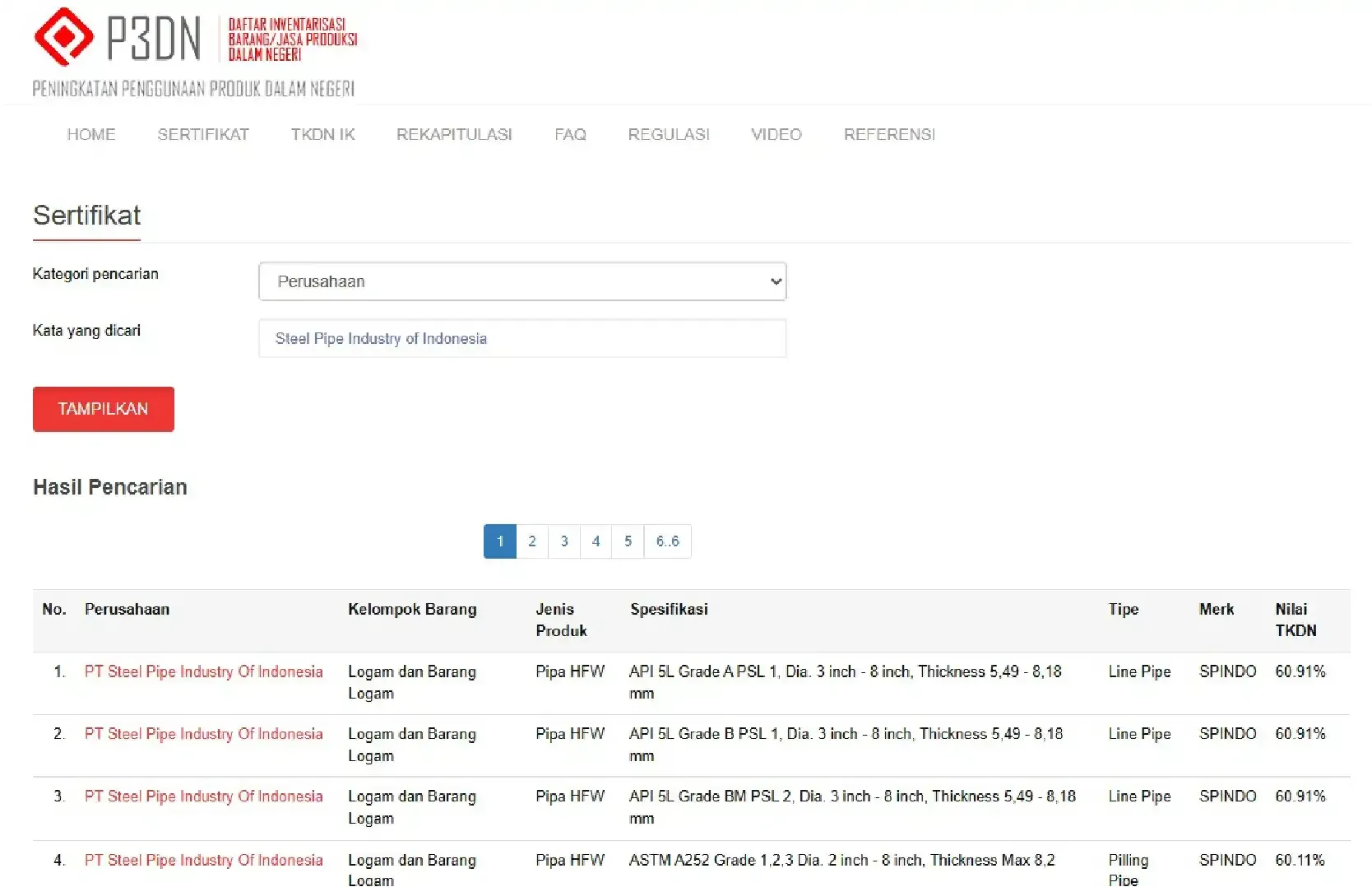
- Search for the manufacturer or product through the official P3DN channel of Indonesia’s Ministry of Industry.
- Ensure that the product name matches the pipe that will be used.
- Check the listed TKDN value.
- Verify the certificate number and validity period.
- Review the covered dimensions, product types, or production locations when stated.
- Match the certificate with the quotation, technical data sheet, and shipping documents.
- Keep a copy of the certificate as part of the procurement documentation.
- Review the tender requirements regarding TKDN and BMP values.
These checks are important because a certificate may have limitations related to its product scope and validity period. Information used in a tender should always come from the latest applicable certificate.
SPINDO and Steel Pipe TKDN
As a national steel pipe manufacturer, PT STEEL PIPE INDUSTRY OF INDONESIA Tbk (SPINDO) provides steel pipe products supported by certifications and documentation for various project requirements.
TKDN support adds value to SPINDO products, particularly for government, state-owned enterprise, and strategic projects that encourage the use of domestic products.
However, users must still check the certificate for each specific product. TKDN values may vary depending on product type, production process, product specification, or certification scope. Before including a SPINDO product in tender documents, verify:
- the product name stated on the certificate;
- TKDN value;
- certificate number;
- validity period;
- covered specifications; and
- compatibility with the product being offered.
Verification can be conducted through the official P3DN system of Indonesia’s Ministry of Industry or by reviewing the latest documents provided by the SPINDO team.
The Impact of TKDN on Project Stakeholders
- For Project Owners
TKDN helps project owners direct the use of domestic products and document compliance with procurement policies.
- For Contractors
Contractors can use TKDN certificates as part of bid documents, material approval submissions, and domestic product utilization reports.
- For Consultants
Consultants should ensure that project specifications include not only technical requirements but also TKDN provisions when required by the project.
- For Procurement Teams
Procurement teams must match the certificate with the product, validity period, TKDN value, and tender requirements before conducting an evaluation.
- For Manufacturers
TKDN certification allows manufacturers to demonstrate their domestic contribution in a measurable way and improve their opportunities to participate in procurement processes that apply P3DN requirements.
Frequently Asked Questions About Steel Pipe TKDN
- What is steel pipe TKDN?
Steel pipe TKDN is a percentage that indicates the level of domestic content in a steel pipe product.
- Why is steel pipe TKDN important?
TKDN helps projects identify domestic products, meet certain procurement requirements, and support the implementation of the P3DN program.
- Does TKDN determine steel pipe quality?
Not directly. TKDN indicates domestic content. Steel pipe quality is still determined by the material, technical standards, dimensions, manufacturing process, testing, and suitability for the intended application.
- Are all projects required to use steel pipes with TKDN?
Not all projects have the same requirements. The obligation depends on the source of funding, procurement type, applicable regulations, and project owner requirements.
- Where can the TKDN value of SPINDO steel pipes be checked?
The TKDN value can be checked through the official P3DN channel of Indonesia’s Ministry of Industry or through the latest certificate provided by SPINDO.
- Does one TKDN certificate apply to all pipes produced by a manufacturer?
Not necessarily. A certificate may apply only to specific product types, specifications, production processes, or locations. The product being offered must therefore be matched with the scope of the certificate.
Conclusion
Steel pipe TKDN is important for infrastructure projects because it supports the use of domestic products, strengthens the national manufacturing industry, and helps fulfill certain procurement requirements. However, TKDN is not a substitute for technical standards. Steel pipe selection must still consider material, dimensions, wall thickness, working pressure, coating, certification, testing, and application conditions.
The correct approach is not to choose between TKDN and quality. Instead, project teams should ensure that the selected steel pipes:
- comply with the project’s technical specifications;
- have verifiable quality documents;
- are supported by a valid TKDN certificate; and
- meet the applicable procurement requirements.
For infrastructure steel pipe requirements, select products that meet the technical specifications and are supported by relevant TKDN documentation.
Check the TKDN value of SPINDO products through the official P3DN channel of Indonesia’s Ministry of Industry and consult the SPINDO team regarding your project requirements.