
P3DN: Definition, Objectives, and Its Relationship with TKDN
P3DN is a government program designed to increase the use of domestic products, particularly in the procurement of goods and services. The program aims to strengthen national industries, reduce dependence on imported products, and ensure that production activities and economic added value remain within Indonesia.
In its implementation, P3DN is closely related to TKDN, or the Domestic Component Level. The TKDN value indicates the amount of domestic content contained in goods, services, or a combination of goods and services.
What Is P3DN?
P3DN stands for Peningkatan Penggunaan Produk Dalam Negeri, or the Increasing Use of Domestic Products. This program encourages the use of goods and services produced or provided by companies that invest and carry out production activities in Indonesia.
According to the Ministry of Industry, the P3DN program is intended to empower domestic industries, strengthen the national industrial structure, and optimize the use of local products in government procurement of goods and services. P3DN is not only related to purchasing local products. It is also associated with strengthening employment, investment, production capabilities, and industrial supply chains in Indonesia.
In government procurement, the use of domestic products should also be considered from the stage of preparing technical specifications or terms of reference. Product selection is adjusted to the capabilities of national industries listed in the Ministry of Industry’s domestic product inventory.
What Are the Objectives of the P3DN Program?
The P3DN program has several main objectives:
- Increasing the use of domestic products
P3DN encourages government institutions, state-owned enterprises, regionally owned enterprises, contractors, project owners, and industry players to prioritize domestic products as long as those products meet the required specifications. This policy provides greater opportunities for national manufacturers to supply goods and services for various projects in Indonesia.
- Strengthening national industries
Increasing the use of domestic products can encourage the growth of national production activities. When demand for local products increases, companies can expand their production capacity, improve product quality, develop technology, and strengthen their competitiveness. The impact can also be experienced by raw material suppliers, distributors, logistics companies, service providers, and the domestic workforce.
- Reducing dependence on imported products
Excessive dependence on imported products can make national industries vulnerable to supply chain disruptions, changes in international prices, and exchange rate fluctuations. Through P3DN, the demand for goods and services is expected to be fulfilled by domestic industries as long as the available products meet technical specifications, quality standards, capacity requirements, and project delivery schedules.
- Encouraging investment and job creation
Greater demand for local products can encourage companies to increase investment, construct production facilities, and develop technology. Growth in production activities can also create new jobs and improve the competencies of the national workforce.
- Strengthening the national supply chain
P3DN encourages the involvement of more local companies in production and distribution processes. With a stronger supply chain, national industries can become more independent and less dependent on supplies from outside Indonesia.
What Is TKDN?
TKDN stands for Tingkat Komponen Dalam Negeri, or the Domestic Component Level. TKDN is a value that indicates the amount of domestic content in goods, services, or a combination of goods and services. For manufactured products, the TKDN calculation may consider several components, including direct raw materials or materials, direct labor, production costs, manufacturing processes, the use of production facilities in Indonesia, and other components stipulated under the applicable regulations.
The TKDN value is expressed as a percentage. The higher the value, the greater the domestic content calculated in the product or service.
However, the TKDN value is not the only factor that should be considered when selecting a product for a project. Users must also consider technical specifications, product standards, product quality and durability, production capacity, delivery capability, after-sales service, and the validity period of the TKDN certificate.
Therefore, a product with a high TKDN value must still meet the project’s technical requirements and specifications.
What Is the Relationship Between P3DN and TKDN?
P3DN and TKDN are closely related, but they have different functions. In simple terms:
- P3DN is a program to increase the use of domestic products.
- TKDN is a value that indicates the level of domestic content in a product or service.
- BMP is a value that indicates a company’s benefits and contribution to the development of national industries.
P3DN can be understood as the policy or program, while TKDN is one of the instruments used to measure domestic content.
In the procurement process, the TKDN value can be used as one of the bases for assessing whether a product supports the policy of using domestic products.
Differences Between P3DN, TKDN, and BMP
| Term | Definition | Function |
|---|---|---|
| P3DN | Increasing Use of Domestic Products | Encourages the use of goods and services produced in Indonesia |
| TKDN | Domestic Component Level | Measures the percentage of domestic content in goods or services |
| BMP | Company Benefit Weight | Assesses a company's contribution to the development of national industries |
What Is BMP?
BMP stands for Bobot Manfaat Perusahaan, or Company Benefit Weight. BMP is used to assess the benefits provided by a company to the development of national industries. The assessment covers several aspects, including:
- employment absorption;
- company investment;
- partnerships with local companies;
- supply chain strengthening;
- human resource development;
- use of technology;
- implementation of green industry practices;
- ownership of domestic brands; and
- contribution to export activities.
Unlike TKDN, which assesses the domestic content of a product or service, BMP focuses more on a company’s contribution to the national economy and industrial development. TKDN and BMP can be used together to provide a more complete overview of the contribution made by a product and a company to domestic industries.
Why Is P3DN Important for Industry?
P3DN is important because the use of domestic products can create a broader impact than a purchase transaction alone. When a project uses local products, the resulting demand can support production activities, employment absorption, distribution, logistics, and the use of domestic raw materials. For manufacturers, P3DN provides opportunities to:
- expand their market;
- increase production capacity;
- strengthen competitiveness;
- develop technology;
- improve product quality; and
- build a stronger supply chain.
For contractors, consultants, procurement teams, and project owners, P3DN provides guidance in selecting products that not only meet technical specifications but also support the growth of national industries.
What Are the Benefits of P3DN for Projects?
The implementation of P3DN can provide several benefits for projects, including:
- Facilitating compliance with procurement requirements
In certain projects, the use of domestic products may be one of the procurement requirements. Products with TKDN certificates can help users comply with these requirements.
- Supporting product availability
Using products from domestic manufacturers can simplify coordination regarding material requirements, production schedules, delivery, and technical support.
- Strengthening technical support
Local manufacturers are generally easier to contact for product consultation, document verification, technical services, and the resolution of on-site issues.
- Reducing supply chain risks
Products manufactured in Indonesia can help reduce dependence on import processes and international shipping.
However, these benefits still depend on production capacity, raw material availability, project location, and the company’s ability to meet technical requirements and delivery schedules.
What Is the Relevance of P3DN to the Steel Pipe Industry?
Steel pipes are used in various strategic sectors. Due to their extensive applications, steel pipes are one of the product groups that are relevant to the implementation of P3DN. The use of domestically manufactured steel pipes can help projects meet their material requirements while supporting the capacity of national industries.
When selecting steel pipes for projects that implement P3DN, users need to consider the following factors:
- pipe type and function;
- required product standards;
- pipe diameter and thickness;
- material type;
- coating type;
- product TKDN value;
- TKDN certificate number;
- certificate validity period;
- production capacity; and
- product compliance with project specifications.
This verification is important because TKDN values may differ for each product type, model, size, material, and production process. Products from the same company or brand do not necessarily have the same TKDN value.
SPINDO Steel Pipe Products’ Support for P3DN
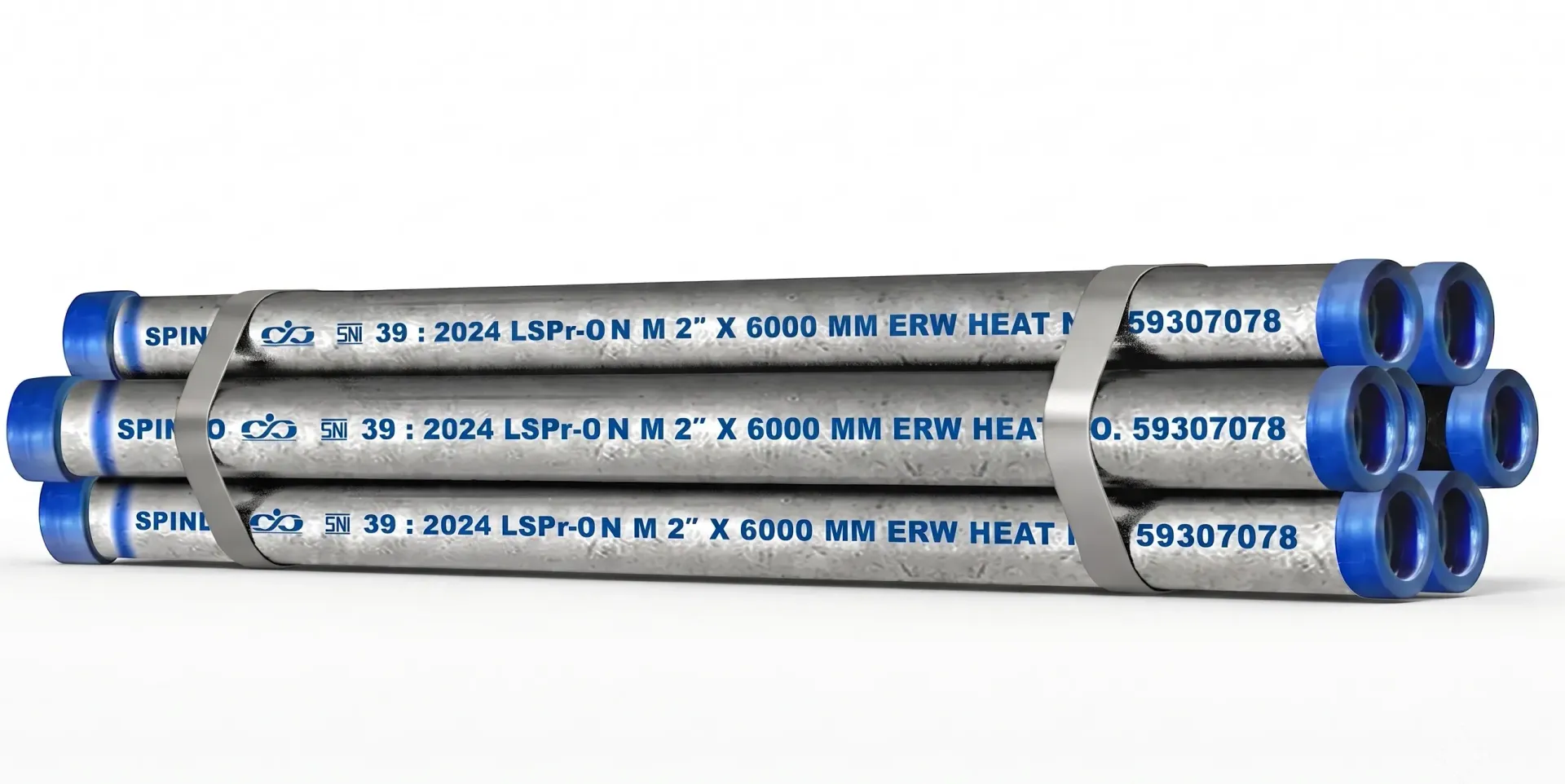
As a national steel pipe manufacturer, PT STEEL PIPE INDUSTRY OF INDONESIA Tbk (SPINDO) provides various steel pipe products for construction, infrastructure, water distribution, energy, oil and gas, automotive, furniture, and other industrial sectors. Several SPINDO products have TKDN certificates that can be checked through the official P3DN portal of the Ministry of Industry.
The TKDN value of each product may vary depending on the product category, pipe type, size, material, production process, coating type, and other specifications. Therefore, users need to ensure that the selected product is covered by a valid TKDN certificate.
Verification should be conducted based on the company name, product name, brand, type, specifications, certificate number, TKDN value, and certificate validity period.
Read Also:
Factory Acceptance Test (FAT) & First Shipment Pipes for Karian Dam-Serpong Project (KSCS)
Does a High TKDN Value Guarantee the Best Product?
A TKDN value indicates the amount of domestic content in a product, but it does not directly indicate that the product has the highest technical quality. When selecting a product, users must still consider compliance with standards, material quality, test results, product certifications, manufacturer capabilities, previous usage experience, delivery accuracy, and technical support. Therefore, the TKDN value should be considered together with technical, commercial, and operational evaluations.
Conclusion
P3DN is a government program designed to increase the use of domestic products and strengthen national industries. In its implementation, TKDN is used to indicate the amount of domestic content in goods, services, or a combination of goods and services.
Meanwhile, BMP is used to assess a company’s contribution to the development of national industries. In simple terms:
- P3DN is the program or policy.
- TKDN is the domestic content value of a product or service.
- BMP is the value of a company’s benefits to national industries.
For the steel pipe industry, P3DN creates greater opportunities to use national products in construction, infrastructure, water, utilities, energy, oil and gas, and other industrial projects.
However, product selection should not be based solely on the TKDN value. Users must also verify technical specifications, standards, quality, production capacity, certificate numbers, and certificate validity periods.
Frequently Asked Questions
What is P3DN?
P3DN stands for Peningkatan Penggunaan Produk Dalam Negeri, or the Increasing Use of Domestic Products. The program aims to encourage the use of goods and services produced or provided in Indonesia.
What are the objectives of P3DN?
P3DN aims to increase the use of local products, strengthen national industries, reduce dependence on imported products, create jobs, and strengthen domestic supply chains.
What is the relationship between P3DN and TKDN?
P3DN is a program or policy designed to increase the use of domestic products. TKDN is a value that indicates the amount of domestic content in a product or service.
What is the difference between TKDN and BMP?
TKDN measures the domestic content of a product or service. BMP measures a company’s benefits and contribution to the development of national industries.
Is a product with a high TKDN value always suitable for a project?
Not necessarily. The product must still meet technical specifications, quality standards, capacity requirements, delivery schedules, and other project requirements.
Do all products from the same company have the same TKDN value?
No. TKDN values may differ based on the product type, material, size, production process, model, and specifications.
Is P3DN relevant to steel pipe products?
Yes. Steel pipes are widely used in construction, infrastructure, water distribution, utilities, energy, oil and gas, and manufacturing projects that may implement domestic product usage policies.